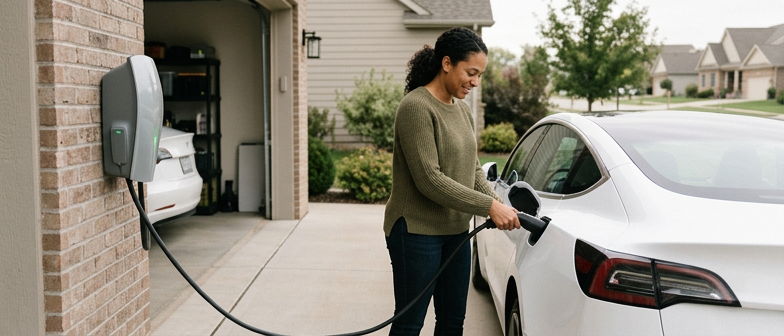
Understanding Home Electric Vehicle Charging Basics
Home Electric Vehicle Charging Basics start with the fact that most drivers recharge where they park overnight, using Electric Car Charging Equipment that can be as simple as a portable cable or as permanent as a wall-mounted unit. Home charging supplies alternating current from your household electrical system to the vehicle’s onboard charger, which converts it into direct current stored in the battery. To keep this safe and reliable, you need compatible connectors for your region, a suitable outlet or home chargepoint, and protection such as circuit breakers and ground-fault devices, so that plugging in becomes a normal, simple part of using an electric car.
Typical home setups fall into two broad types. The cable supplied with the car usually plugs into a standard socket and offers lower power and slower charging, while a professionally installed charger on a dedicated circuit delivers more power and faster replenishment. These units may show charging status and sometimes allow basic monitoring of energy use, but the core purpose is straightforward: provide convenient overnight charging so most daily driving can be covered without regular trips to public chargepoints. Understanding how your home’s electrical capacity matches the type of equipment you use and your driving habits helps you choose a safe, dependable arrangement that fits your routine.
Level 1 EV Charging at Home
Level 1 EV charging uses a standard 120‑volt household outlet and the portable cable supplied with most electric cars. It is the simplest way to begin home electric vehicle charging because it usually needs no special installation beyond confirming that the outlet and circuit are in good condition. The car’s onboard charger manages how much power is drawn while the cable and outlet safely deliver electricity to the battery. This basic setup works best for drivers who can park near an outlet and have predictable daily routines, allowing the vehicle to recharge gradually whenever it is at home.
In most EV charging time guides, Level 1 is described as the slowest home option, typically adding only a few miles of range per hour. Overnight charging can cover many short commutes, but larger batteries or long daily trips may demand more time or a faster solution. Level 1 charging can be enough if your driving needs are modest and you are willing to plan around slower replenishment, and it also serves as a backup when a faster charger is unavailable. Knowing these limits helps you decide whether this basic electric car charging equipment suits your routine or whether you may eventually want a Level 2 home charger for quicker charging.
| Daily driving pattern | Parking and outlet access | Suitability of Level 1 | Typical notes |
|---|---|---|---|
| Short commute and local errands | Home parking with easy outlet reach | Highly suitable | Overnight charging usually replenishes daily use |
| Moderate commute with occasional longer trips | Regular home parking, occasional away stays | Borderline | May need planning or occasional Level 2 or public charging |
| Long daily mileage or frequent highway use | Consistent home parking but limited time plugged in | Generally less practical | Slow recharge can struggle to keep up with daily range needs |
| Second car used infrequently | Stored at home with stable outlet access | Highly suitable | Gradual charging adequate between occasional drives |
| Street or shared parking without outlets | Unreliable access to a suitable socket | Not suitable | Practical use depends on finding alternative charging options |
When a Level 1 Setup Works Well
A basic Level 1 EV charging arrangement, using a standard household outlet, can be a practical solution when daily driving needs are modest and the car sits parked for long stretches. For people with short commutes, regular local errands, or a second car that is driven only occasionally, the slower charging rate is often offset by consistent overnight charging at home. An EV charging time guide typically shows that Level 1 can add enough mileage over eight to twelve hours to cover many routine trips, so drivers who rarely deplete their battery may find this simple setup adequate without upgrading their home electric car charging equipment.
Choosing and Using a Level 2 Home Charger
A Level 2 home charger is electric car charging equipment that uses a dedicated 240‑volt circuit rather than a standard outlet. Compared with basic Level 1 EV charging, this higher voltage adds range much more quickly and makes daily charging practical for most drivers. For people who commute moderate distances, share a vehicle, or rely on climate control while parked, having faster home charging can reduce how often they visit public stations and make owning an electric vehicle feel easier.
Charging time with a Level 2 home charger depends on your vehicle’s onboard charger and battery size. A typical unit might add about 10 to 25 miles, or 20 to 40 kilometres, of range per hour, while a Level 1 setup usually delivers only a few miles in the same period. An EV charging time guide from your carmaker or local energy agency can help you estimate how long an overnight session will take. Even with a Level 2 system, speed is limited by the car’s hardware, the circuit’s amperage, and any charging limits you set in the vehicle, so different models can reach full charge at different times on the same equipment.
Before installing a Level 2 home charger, consider your electrical panel capacity, typical driving needs, and budget for both equipment and professional installation. An electrician can confirm whether you can add a new circuit or need an upgrade and may recommend adjustable current settings to match your home’s limits. Many chargers now offer scheduling and usage data so you can favor off‑peak charging, when electricity prices may be lower and grid demand lighter. Choosing a unit with an appropriate power rating, useful smart features, and straightforward controls helps fit home charging into your routine while maintaining basic safety and reliability.
Practical Installation and Cost Considerations
A Level 2 home charger usually needs a dedicated circuit and adequate panel capacity, so homeowners should have a qualified electrician review wiring and other electric car charging equipment to avoid overloading the system. Installation typically involves mounting the unit, running cable from the panel, and fitting a correctly rated breaker, with costs driven by cable runs, any trenching or wall work, and possible service upgrades. Grants, tax credits, utility incentives, and off-peak charging programs can lower the upfront cost and ongoing bills when the charger meets required safety and smart charging standards, so it is worth comparing quotes and confirming local permitting rules before committing.
Home Charging Safety Basics
Safe home charging starts with appropriate electric car charging equipment and a sound electrical installation. Use a dedicated circuit for the charger and avoid sharing it with high‑demand appliances, which can overload wiring and breakers. A professionally installed Level 1 or Level 2 home charger should have proper grounding, correctly sized cables, and residual current or similar protection to reduce shock risk. Outdoor charge points need weather‑resistant enclosures and positioning that protects them from standing water, impact, and excessive heat. Before plugging in, check that the outlet or wallbox shows no damage, discoloration, or burning, and avoid adapters or extension leads that are not clearly rated for EV charging loads.
Day‑to‑day habits also matter. Keep cables fully unwound, clean, and free of tight kinks to limit heat build‑up and trip hazards, and store them off the ground to protect insulation. Inspect connectors and cable jackets for cracks, exposed wire, or loose pins, and stop using the equipment if you notice unusual heat, smell, or noise while charging. Follow the manufacturer’s instructions for your home charger, including ventilation and maximum current, and do not modify the device or bypass safety features. When planning to upgrade from basic Level 1 charging to a higher‑power home unit, or if you are unsure about off‑peak charging settings and local load, consult a qualified electrician.
Q&A
-
What are the basics of home electric vehicle charging?
Home EV charging supplies AC from your house wiring to the car’s onboard charger, which converts it to DC for the battery. You need the proper connector, a suitable outlet or wall unit, and protection such as breakers and ground‑fault devices. -
How does Level 1 charging work and who does it suit?
Level 1 uses a standard 120‑volt outlet and the portable cord included with many electric cars. It fits drivers with short daily trips, predictable routines, and enough time for slow overnight charging. -
When is a basic household outlet usually enough for home charging?
A simple outlet can work if you drive modest miles and the car sits parked for many hours. In 8–12 hours it typically adds enough range for commuting and nearby errands without extra equipment. -
Why do many drivers install a Level 2 home charger?
Level 2 uses a 240‑volt circuit for faster charging, better supporting regular commuting, shared vehicles, and frequent use of cabin heating or cooling while reducing dependence on public stations. -
What safety and cost issues matter, including off‑peak charging?
Use a dedicated, professionally installed circuit with correct grounding, cable size, and outdoor protection where needed. Installation cost depends on wiring and panel capacity, while off‑peak electricity rates can lower ongoing charging bills.